
How to Handle an Eviction in Anne Arundel County: Notices and Next Steps
An eviction in Anne Arundel County follows a court process, not an immediate lockout. After a court issues a Warrant of Restitution, the landlord must give written notice at least 14 days before the eviction date set by the Sheriff’s Office, according to the Anne Arundel County Sheriff’s Office. Understanding how to handle an eviction in Anne Arundel County means knowing what that notice requires and what happens next.
It’s understandable to feel unsettled when a notice arrives, especially when the timing of a hearing, the sheriff’s role, or the fate of belongings is unclear. The notice and court process matter: they shape when an eviction can proceed and what steps follow, while due process concerns may affect how renters respond.
This article explains how notice periods work in Anne Arundel County, what the Sheriff’s Office does, and how belongings are handled during and after an eviction. It also explains why due process matters and what to do when an eviction notice or hearing date arrives.
Key Takeaways
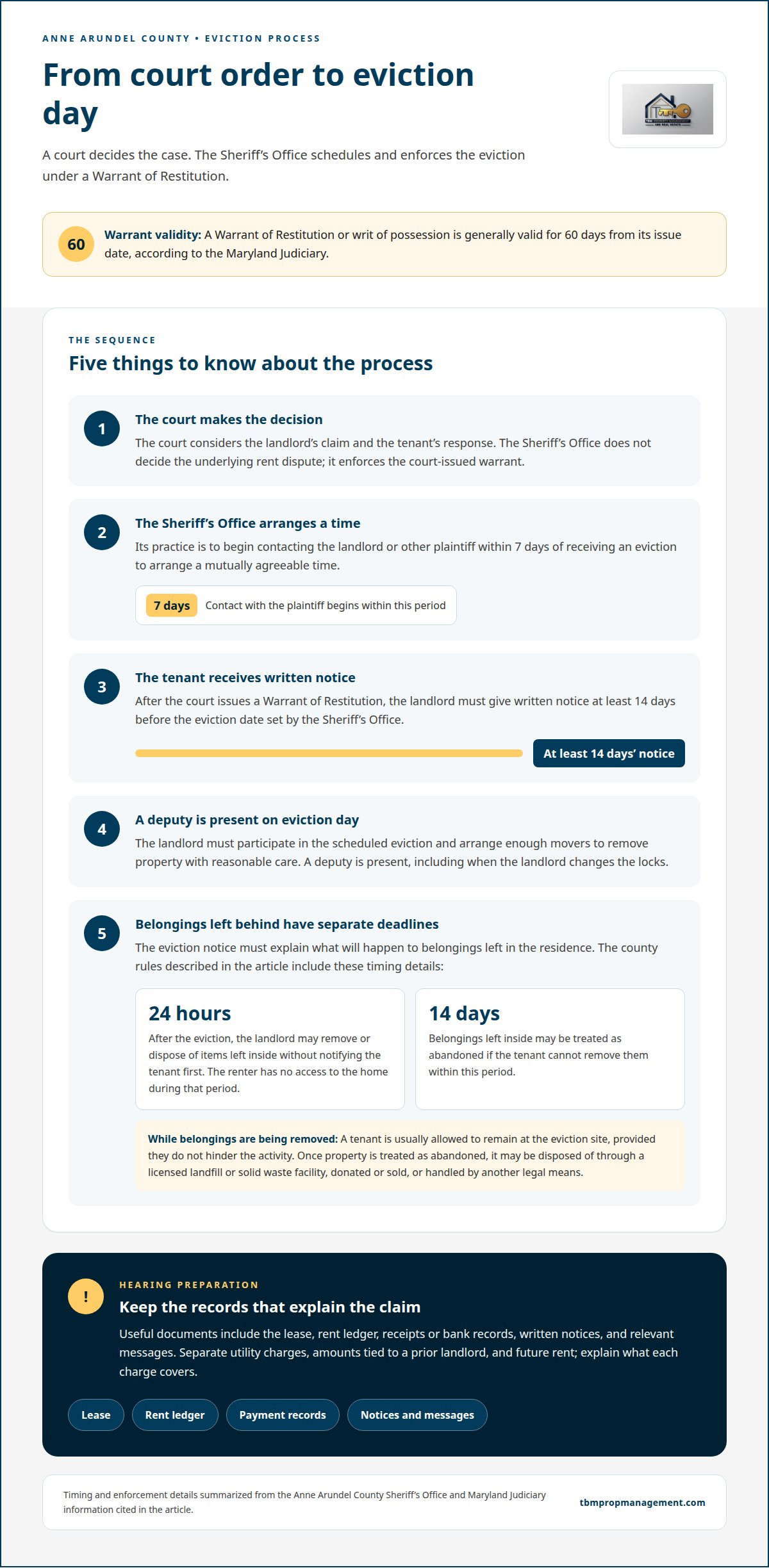
- A Warrant of Restitution or writ of possession is generally valid for 60 days from its issue date, according to the Maryland Judiciary. That timeframe helps explain why the sheriff’s role and scheduling matter.
- Notice requirements depend on the reason for seeking eviction. Learn how lease violations and dangerous activity can call for different notice periods.
- Due process concerns can arise when renters lack timely notice or a meaningful chance to challenge what happens to them or their belongings.
- Rules for property left behind affect what landlords may do after an eviction. Understand the timing and responsibilities before the removal process begins.
Anne Arundel County Sheriff's role in landlord-tenant matters
The court decides the landlord-tenant case. After the court issues a Warrant of Restitution, the sheriff carries out the eviction. Knowing where the court process ends and enforcement begins helps both landlords and tenants prepare.
The Sheriff’s Role in Evictions
The sheriff schedules and enforces an eviction under a court-issued Warrant of Restitution, rather than deciding the underlying rent dispute. In Anne Arundel County, a landlord must give a tenant written notice at least 14 days before the eviction date set by the Sheriff’s Office after a court issues a Warrant of Restitution, according to the Anne Arundel County Sheriff's Office. The sheriff’s office practice is to begin contacting the landlord or other plaintiff within 7 days of receiving an eviction to arrange a mutually agreeable time. A deputy is present during the eviction, including when the landlord changes the locks.
An Anne Arundel County warrant of restitution or writ of possession is generally valid for 60 days from its date of issue, according to the Maryland Judiciary. The landlord must participate in the scheduled eviction and arrange enough movers to remove property with reasonable care. For renters, the scheduled date is a crucial point for understanding when access to the home may end.
Eviction Hearings and Required Documents
At an eviction hearing, the court considers the landlord’s claim and the tenant’s response before deciding the case. Bring records that document the tenancy, the amount claimed, payments made, and notices exchanged. Useful documents include the lease, rent ledger, receipts or bank records, written notices, and relevant messages. Itemize utility charges, amounts tied to a prior landlord, and future rent separately. Explain what each charge covers rather than presenting it as current unpaid rent without context.
Landlords should be ready to explain the payment history and the basis for each charge. Tenants can organize proof of payment or records that dispute the amount. The landlord’s association representative has said some landlords seeking possession may have gone 60 or more days without rent. A renters’ lawyer, by contrast, has said hearings may be scheduled only a day or two ahead, and some renters learn of them on the same day. These differing concerns make clear records and prompt attention to hearing notices especially important.
Due process concerns and legal challenges
Due process concerns arise when renters lack notice or a meaningful chance to challenge eviction-related decisions. In Anne Arundel County, a renters’ lawyer has said hearings may be scheduled only a day or two ahead, and some tenants learn about a hearing on the same day. Short notice can leave little time to gather a lease, payment records, messages, or evidence about the property. Keep these documents together and respond promptly to court notices.
Legal challenges elsewhere in Maryland show why notice about belongings matters. Two years ago, the U.S. Court of Appeals for the Fourth Circuit ruled that Baltimore violated a woman’s due process rights after she received no notice that officials would consider her belongings abandoned and no opportunity to contest their loss. The court upheld $186,000 in damages. That case concerned Baltimore, but it highlights the importance of notice and a chance to be heard when property may be taken.
For a scheduled eviction in Anne Arundel County, tenants can contact Community Legal Services at (240) 391-6370, ext. 5. For failure-to-pay-rent cases, legal help can assist tenants in understanding the claim, reviewing payment records, and preparing a response. Relevant documents may include the lease, rent receipts, account statements, and landlord communications.
Eviction claims may involve unpaid rent, an alleged lease violation, or criminal or dangerous activity. The landlord’s filing should identify its basis, and the tenant’s response should address that reason with relevant records. Filing fees listed for Anne Arundel County include $5 per tenant for a Failure to Pay Rent complaint, $40 for a warrant of restitution in that case, and $40 for a breach-of-lease filing. These are stated fees, not a complete account of every possible court cost.
Renters seeking county eviction-prevention funds generally need an active warrant issued within the previous 60 days or an eviction scheduled by the Sheriff. Household income must be at or below 50% of the county’s Adjusted Median Income; prior assistance within 15 months makes renters ineligible. The maximum payment is the lesser of the amount needed to prevent eviction or $5,000.
Handling renters’ belongings after eviction
After a judgment and Warrant of Restitution, an eviction affects more than access to the home. In Anne Arundel County, the notice must explain what will happen to belongings left in the residence. Read it carefully to understand the consequences before the scheduled eviction.
A tenant is usually allowed to remain at the eviction site while belongings are removed, provided they don’t hinder the activity. The landlord must arrange enough movers and take reasonable care when removing property. Belongings left inside the residence may be treated as abandoned if the tenant cannot remove them within 14 days. The ordinance also allows the landlord to remove or dispose of items left inside 24 hours after the eviction, without notifying the tenant first. During that period, the renter has no access to the home.
Once belongings are treated as abandoned, the landlord may dispose of them through a licensed landfill or solid waste facility, donate or sell them, or use another legal means. An earlier version of the county bill included a six-day period to reclaim property, but that period was removed. Plan to remove essential belongings before the eviction takes place.
Public space has separate restrictions. Landlords may not leave abandoned belongings on public county property. Items left on a County right-of-way for more than 48 hours may be removed by the Department of Public Works, with removal and disposal costs billed to the rental property owner. Article 13, Section 1-106 of the Anne Arundel County Code addresses removal from a right-of-way.
If a pet remains in the residence during an eviction, the landlord must contact the County Department of Animal Services, which is required to seize it. Plan for people, pets, and personal property before the scheduled date. A Warrant of Restitution authorizes law enforcement to remove a tenant and return possession to the landlord. Belongings left behind can quickly become difficult or impossible to recover.
Notice periods for lease violations and dangerous activity
Anne Arundel County notice periods depend on the reason a landlord is seeking possession. The rental issue determines which notice and court steps apply.
Notice Periods for Lease Violations
A lease-violation notice gives a tenant time to correct the violation or leave the rental. The stated period is 30 days for a lease violation, while criminal or dangerous activity calls for 14 days. These distinct periods matter because the landlord’s next steps depend on the alleged conduct. A tenant facing a notice can identify the cited issue and preserve related lease records or communications.
Anne Arundel County Notice Requirements
For a month-to-month tenancy or an expired lease, landlords should provide 60-90 days’ termination notice. That notice period differs from the 30-day lease-violation notice and the 14-day notice for criminal or dangerous activity. The reason for ending the rental arrangement therefore matters. A landlord should clearly distinguish a lease violation from termination of a month-to-month tenancy when communicating the next steps.
Written Notice Before Eviction
Written notice documents the basis and timing of the landlord’s action. After a court issues a Warrant of Restitution, the landlord must give written notice at least 14 days before the eviction date set by the Sheriff’s Office. The notice must explain what will happen to belongings left in the residence. For tenants, reading these details helps them understand the scheduled date and plan to remove personal property.
For landlords and tenants, the broader process starts with the applicable notice, followed by a court filing and hearing. In a failure-to-pay-rent case, a landlord may file after rent is due; after judgment, the landlord may apply for a warrant if the tenant has not vacated by the fifth day. The sheriff then schedules enforcement, rather than the landlord removing a tenant independently. Landlords seeking to reduce future lease disputes can use professional tenant screening.
TBM Property Management
TBM Property Management helps rental owners manage the ongoing work surrounding a tenancy, so they can focus on clear processes rather than handling every detail alone. Its Full-Service Property Management can coordinate key responsibilities, while Tenant Placement and Leasing Services support the steps involved in preparing for a new tenancy. Rent Collection helps organize an essential part of the landlord-tenant relationship.
These services are a practical next step for property owners who want consistent support with leasing and day-to-day rental management. They don’t replace court procedures or legal advice when an eviction case is underway, but organized property management can help owners handle routine responsibilities with greater structure.
If you’d like support managing your rental property, contact TBM Property Management.
Build a More Prepared Rental Operation
Understanding how to handle an eviction in Anne Arundel County can also inform how you manage a rental before problems arise. Clear leasing practices, organized communication, and consistent attention to the tenancy help owners make informed decisions when circumstances change. Consider what support would make managing your rental more straightforward.
TBM Property Management offers Full Service and Full Management for ongoing rental oversight, as well as Tenant Placement & Leasing Only for owners who need help arranging a tenancy. Full Management includes eviction coordination and handling, while all plans support different stages of the rental relationship. These services do not replace legal counsel in a court dispute.
Choose a next step that fits your needs and keeps your rental responsibilities organized. Contact TBM Property Management to discuss support for your property, and move forward with greater clarity.
Frequently Asked Questions
How do Anne Arundel County tenants respond to an eviction notice or failure-to-pay-rent case?
To handle an eviction in Anne Arundel County, read the notice closely, note any hearing or eviction date, and respond through the court process. For a failure-to-pay-rent case, gather receipts, account records, and messages that clarify payments or disputed charges. Organize records by date so the payment history is easy to follow. Tenants facing a scheduled eviction can seek legal assistance promptly.
Where is the District Court of Maryland for Anne Arundel County, and how do you file or respond to an eviction case?
The District Court of Maryland in Annapolis is at 251 Rowe Boulevard, Annapolis, Maryland 21401. Landlords file eviction cases in District Court, and tenants should use the case paperwork to identify the court, case number, and response instructions. Keep a copy of any filing and supporting records, such as the lease or payment history, so the information is organized for the hearing.
What notice must a landlord give before filing for eviction in Maryland?
The notice depends on the reason for seeking eviction. In Anne Arundel County, the stated periods are 30 days for a lease violation and 14 days for criminal or dangerous activity. Month-to-month tenancies or expired leases call for 60-90 days’ termination notice. A failure-to-pay-rent complaint may be filed after rent is due, so distinguish that court filing from later eviction scheduling notice.
How long does an eviction case and warrant of restitution take in Anne Arundel County?
A failure-to-pay-rent hearing is held approximately 7 days after filing, and a breach-of-lease hearing is held seven days after filing. Those hearing estimates don’t set the full duration of a case. The next timing depends on the judgment, whether a warrant is issued, and the sheriff’s scheduling. The warrant’s validity period and the scheduled enforcement date are separate timing questions.
What legal aid and tenant advocacy services help with eviction in Anne Arundel County?
Tenants with a scheduled eviction can contact Community Legal Services at (240) 391-6370, ext. 5. Renters at risk of homelessness can call Anne Arundel County’s 24/7 Community Warmline at 410-768-5522. For county eviction-prevention assistance, applicants generally need an active warrant issued within the previous 60 days or an eviction scheduled by the Sheriff, and must meet the program’s income criteria.
How can a tenant appeal an eviction judgment or request a stay in Maryland?
For anyone deciding how to handle an eviction in Anne Arundel County after a judgment, promptly obtain the written judgment and case paperwork and contact Community Legal Services at (240) 391-6370, ext. 5. Ask about the appeal process, the applicable filing deadline, and whether a separate stay request is needed. Share any scheduled eviction date and relevant documents so legal staff can assess the next steps.