
Local vs National Property Management: Which Fits Your Rental
The right manager isn’t necessarily the one with the closest office or biggest name. When comparing local vs national property management companies, consider how each approach fits your rental. Local managers may know nearby conditions and vendors, while national firms may offer centralized processes and broader support. The key is how those differences affect decisions and service for your property.
It’s reasonable to expect a manager to coordinate maintenance, keep you informed, and make day-to-day oversight feel easier. But a local name alone doesn’t guarantee hands-on service, and a national brand doesn’t tell you exactly who will manage the property. This guide explains how local knowledge, vendor coordination, guest service, and management options can differ, then offers a practical way to weigh local, national, hybrid, and self-management approaches. You’ll be better equipped to choose a structure that matches your rental, your priorities, and the level of involvement you want.
Key Takeaways
- Judge a management company by the team and processes serving your property, not just by whether its brand is local or national.
- Compare how managers use local knowledge to guide rental decisions and coordinate vendors, while remembering that proximity alone doesn’t ensure faster repairs.
- Clarify who handles maintenance decisions, guest communication, and on-the-ground responsibilities before choosing a management structure.
- Use your desired level of involvement to weigh local, national, hybrid, and self-management options, then focus on the approach that best fits your rental.
What Counts as a Local Property Management Company?
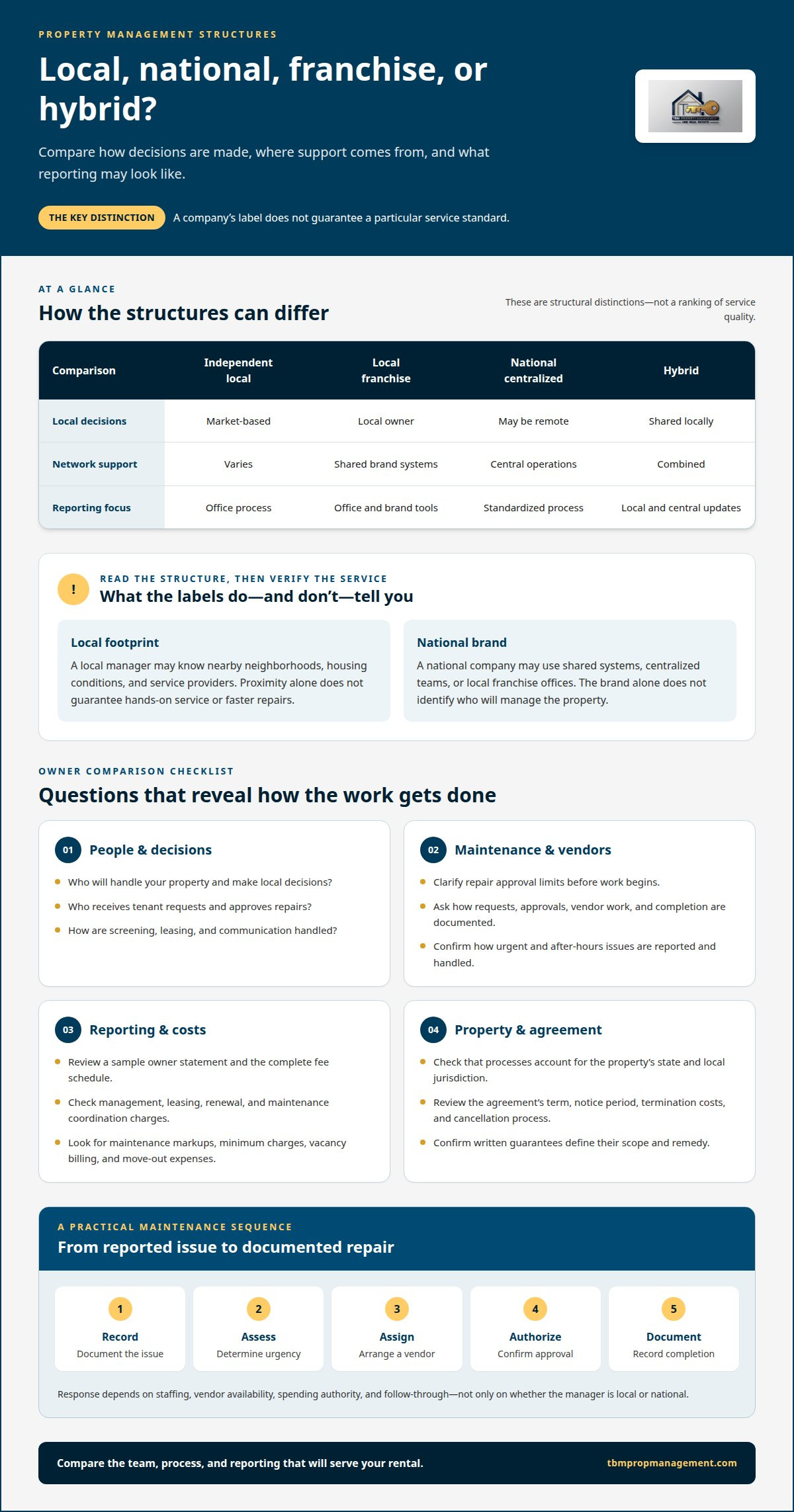
A local property manager works in the rental’s market and may know nearby neighborhoods, housing conditions, and service providers. But “local” describes a footprint, not a service standard. Compare who will handle your property, what decisions they can make, and how clearly they report their work to owners.
A national brand may operate through franchises, with a local owner running an office under a shared name. Network support can provide established systems, but service depends on the specific office and its team. Other national companies may handle some functions remotely. Ask who makes local decisions and coordinates work at the property.
Local and national managers can both handle tenant screening and leasing. Compare their screening process, leasing responsibilities, communication, and approach to evaluating applicants. A local office may know the Maryland rental market, while a national operator may use consistent processes across locations.
Review a sample owner statement and the complete fee schedule. Management, leasing, renewal, and maintenance coordination charges can all affect the total. Look for maintenance markups, minimum charges, vacancy billing, and move-out expenses. Reports should show what maintenance was requested, approved, and completed. Clarify repair approval limits before work begins.
Rental requirements depend on the property’s state and local jurisdiction. For a Maryland rental, consider the rules that apply where the property is located, including county or municipal requirements. A manager’s processes should account for that jurisdiction rather than rely solely on a national template.
Read the agreement for its term, notice period, termination costs, and cancellation process. It should also explain repair approval limits and move-out expenses. Written guarantees should define their scope and remedy. An owner portal can make statements and maintenance updates easier to access, but the detail in those reports matters more than the portal itself.
| Option | Local decisions | Network support | Reporting focus |
|---|---|---|---|
| Independent local | Market-based | Varies | Office process |
| Local franchise | Local owner | Shared brand systems | Office and brand tools |
| National centralized | May be remote | Central operations | Standardized process |
| Hybrid | Shared locally | Combined | Local and central updates |
Choose the management structure that fits your property’s needs, your desired involvement, and your reporting expectations.
Local knowledge, vendor relationships, and guest hospitality
Local knowledge matters when it changes a rental decision. A Maryland rowhouse and a newer apartment call for different inspection priorities, access plans, and maintenance coordination. A manager familiar with the property type can account for those details during leasing and routine oversight. Look for examples of how neighborhood and building features shape recommendations, not just a general claim of local expertise.
Neighborhood context helps explain how a rental fits its immediate market. For instance, a home with limited parking should say so clearly in its listing. Nearby amenities, property condition, and renter feedback can also inform leasing decisions. A manager should consider each home on its own merits rather than treating every Maryland neighborhood as interchangeable. Local knowledge is most useful when it informs practical choices about the property.
Vendor relationships matter when repairs need careful coordination. A manager can document a request, arrange access, communicate about the work, and record its completion. Before an issue arises, set spending limits and identify who approves repairs. A local contact may know contractors serving the area, though availability depends on the circumstances. Reports should connect each repair request with its approval and completed work.
A renter’s experience depends on practical details. Clear arrival instructions, helpful communication, and a well-maintained property all matter. For long-term rentals, respectful communication with tenants and attention to maintenance help address concerns. An inspection can identify issues before leasing begins or after a tenant moves out. Consistent processes matter whether communication comes from a local team or a centralized operation.
Ask managers for examples of decisions shaped by local knowledge, how inspections inform property care, and how owners receive updates. They should also explain tenant screening and leasing processes clearly. The best fit is a manager whose local understanding translates into practical oversight and a dependable rental experience for tenants.
Maintenance coordination and vendor networks
Response times depend on more than whether a manager works locally or nationally. Staffing, vendor availability, spending authority, and follow-through all shape how quickly a repair moves from request to completion. A nearby office can help coordinate access, while a national operation may route requests through centralized teams and local field staff.
For a leaking pipe, the process should be clear: record the issue, assess its urgency, assign a vendor, authorize the work, and document completion. Agree in advance on who receives tenant requests and who can approve repairs. Knowing each step helps owners understand where delays might occur and who is responsible for moving the work forward.
After-hours calls need a defined process, not an assumption about availability. The management agreement should explain how urgent issues are reported, who decides whether to dispatch a vendor, and what spending authority applies. A routine repair may follow normal approval steps, while an active leak may need a different response. Put the contact and authorization process in writing.
Vendor networks vary by market. Local relationships may help identify contractors familiar with an area, while a larger network may have established vendor processes. Neither structure guarantees availability. Maintenance records should show the work requested, vendor charges, approval, and final completion. That record helps owners make informed decisions about recurring repairs and property upkeep.
Compare the full management fee schedule, not just its headline charge. Ask how maintenance coordination, leasing, and renewal work are billed, and whether vendor markups or minimum charges apply. Markups can change the total cost of a repair, so reports should make the work and charges easy to understand. For property owners, transparent records help distinguish a one-time fix from a pattern that may need broader attention.
Choose a manager whose repair process fits your property and desired level of involvement. Clear authorizations, documented vendor work, and consistent updates make maintenance easier to oversee, whether the operation is local, national, or hybrid.
Choosing between national, local, hybrid, and self-management
National companies typically use broader systems, while local firms focus on a specific market. Their main differences concern decision-making, housing knowledge, service structure, and agreement terms.
National Property Management
A national manager can offer standardized processes across a broad residential portfolio. In vacation rentals, national operators commonly centralize pricing, marketing, reservations, and guest messaging, with local field staff handling on-site work. That structure may suit owners with properties across markets or those who prefer consistent systems. The key is who controls local decisions and how the agreement assigns responsibilities.
Local Property Management
A local manager focuses on rentals in a defined area and can tailor decisions to nearby housing conditions. Owners may value direct communication with a local team and familiarity with neighborhood demand. This approach can suit a single-market portfolio where local leasing and property needs matter most. Evaluate the office’s processes and responsibilities, not just its location or name.
A hybrid arrangement divides responsibilities between central operations and local staff. For example, a central team might manage reporting while a local team coordinates inspections and vendor access. This can combine standardized administration with on-the-ground knowledge, but only if the agreement clearly assigns approvals, communication, and follow-through.
Self-management gives owners direct control over leasing, tenant communication, maintenance decisions, and reporting. It may suit someone with time to handle those tasks and a manageable portfolio. Consider the work involved during vacancies, repairs, and tenant changes, not just routine months. Let your preferred level of involvement and your property’s needs guide the decision.
Use this decision guide: choose national management for consistency across markets, local management for focused area knowledge, hybrid management for divided responsibilities, or self-management for hands-on control. Then match the agreement to your priorities, including decision authority, reporting, and service scope. Discuss your property management needs to explore a structured approach for your rental.
TBM Property Management
TBM Property Management helps owners who want consistent support without handling every responsibility themselves. Its Full-Service Property Management brings day-to-day oversight together, while Tenant Placement and Leasing Services support owners preparing a property for renters. Rent Collection can also reduce the administrative work of managing ongoing tenancies.
If you’re weighing management models, consider which responsibilities you want to delegate and where structured support would make ownership easier. A conversation with TBM Property Management can help match your priorities with a suitable approach for your rental.
Contact TBM Property Management to discuss your property management needs.
Choose a management approach that can grow with your rental
Your management needs may change as your priorities shift. A hands-on approach might suit you now, while future responsibilities could make delegated support more valuable. Treat the choice as a working plan, not a permanent label. Revisit who handles decisions, communication, and property oversight whenever your circumstances change.
That perspective can make comparing local vs national property management companies more useful: focus on the arrangement that fits your rental today and can adapt as your needs evolve. If you’re ready to make day-to-day ownership feel more manageable, start a conversation with TBM Property Management about the support you’re looking for.
A clear next step can give you greater confidence in your rental decisions. Choose the level of involvement that feels right, then move forward at a pace that works for you.
Frequently Asked Questions
Are National Property Management Fees Higher?
Not automatically. A national company’s scale doesn’t determine whether its fees are higher than a local manager’s. When comparing local vs national property management companies, consider the same rental tasks and billing assumptions for each. Review the complete schedule, including leasing, renewals, vacancy billing, maintenance charges, and termination terms. Then compare expected costs for your property and management needs, rather than treating the headline management rate as the full price.
How Do Local and National Firms Handle Vacancies Differently?
Vacancy handling depends on the manager’s workflow, not just its geographic reach. A national firm may centralize advertising and applicant communications, while a local manager may coordinate showings through nearby staff. In either case, consider how listing feedback informs the next decision. If prospective renters view a home but don’t apply, the asking rent, listing details, or presentation may need attention.
Is a Locally Owned Franchise Different From a National Company?
Yes. A franchise can use a national brand while a local owner operates the office. That differs from a company whose local operations are managed directly by its central organization. The distinction affects who runs the office, how local decisions are made, and how support is structured. The management agreement should identify the responsible entity and explain where owners can direct instructions or concerns.
Can a National Manager Price a Maryland Rental Accurately?
Yes, if the pricing process reflects the specific home and its local rental market. Property condition, amenities, nearby competition, and actual inquiries or applications can all inform a useful estimate. A broad market figure alone may miss differences between homes, so pricing decisions should account for the property’s features and renter response. Clear communication about these factors helps owners understand the recommended asking rent.
How do local and national property management companies compare on fees and pricing?
Compare the full agreement, because two managers may include different work under similar-looking rates. Separate recurring management charges from leasing, renewal, maintenance coordination, and other possible fees. Then consider how vacancy billing, minimum charges, markups, and cancellation terms affect expected costs. Use the same rental assumptions for each comparison so the result reflects services and contract terms, not just a headline percentage.
What are the benefits of hiring a local property management company?
A local manager may know nearby rental conditions and the area’s housing stock. That context can help interpret renter feedback, coordinate property access, and tailor leasing decisions to the neighborhood. For example, familiarity with older homes can help explain how layout or upkeep affects a showing. The value comes from applying local insight to the property, not simply having a nearby office.