Managing Multi-Family Properties in PG County: Licensing and Maintenance
Can you end a property management contract if the service isn’t working for you? Start with the agreement’s termination clause and notice requirements, then review the manager’s responsibilities. Managing multi-family properties in Prince George’s County also involves fees, maintenance coordination, licensing, and inspections, so unclear responsibilities can quickly create extra stress.
You deserve to know what a management fee covers and how routine repairs, urgent issues, and inspections are handled. This guide explains what services to look for, how local rental licensing and inspections fit into property oversight, and what to review before ending a contract. With a clearer picture of each responsibility, you can make a more informed decision about managing your property and the support you need.
Key Takeaways
- Identify which tenant services and rent collection tasks a management fee covers before deciding whether the arrangement fits your property.
- Understand how rental licensing and inspections apply locally so you can keep compliance and property oversight on your radar.
- Clarify how maintenance requests are coordinated and how repair responsibilities are handled across the property.
- Review the contract’s services, fee terms, and termination provisions to make a more informed decision about your management arrangement.
What services does the management fee include?
A management fee may cover leasing coordination, tenant communication, rent collection, account records, and follow-up on overdue rent. The agreement defines the exact scope, so distinguish routine management tasks from work or charges outside that scope. For owners managing multifamily properties in Prince George’s County, clearly assigned responsibilities help prevent missed payments and confusion between residents and management.
Rent collection should follow a consistent process. Online payment platforms can collect rent and send tenant reminders. A useful workflow records payments by unit, flags missed or partial payments, and tracks follow-up. For a College Park multifamily property, a unit-by-unit ledger helps distinguish one resident’s balance from another’s and identify unresolved arrears.
Good tenant service also gives residents a clear way to report questions and payment issues. A proactive process logs each request, records the response, and tracks the next step. The agreement should explain which tenant communications are included, how payments are recorded, and how overdue balances are handled. Those details make fees easier to evaluate without assuming every agreement covers the same tasks.
How does managing multifamily properties in Prince George’s County compare with Montgomery County and Washington, DC? The core work includes leasing, tenant communication, and rent tracking, but licensing and rental requirements can vary by jurisdiction. Property oversight should account for the specific location rather than treating Maryland counties and Washington, DC, as interchangeable.
What are Prince George’s County landlord-tenant laws, including security deposit and eviction rules? Landlords must follow applicable state and local requirements, and should also be familiar with the federal Fair Housing Act. A sound management process keeps deposit records, payment histories, notices, and tenant communications organized for each tenancy.
What qualifies as a multifamily property in Prince George’s County, Maryland? Small multifamily properties can contain two to four rental units. Whether a College Park property fits that description depends on its unit configuration and residential use.
Local rental licensing and inspections
Residential rental property management in Prince George’s County starts with identifying the requirements that apply to the property and its use. Review state, local, and federal requirements, then keep license documents, inspection results, repair requests, and completed work together. Organized records help owners track compliance and address issues before they become larger property concerns.
Rental licensing and building permits serve different purposes. Applications for a new multifamily dwelling building permit in Prince George’s County go through the Momentum portal and the County’s Permitting System. The application requires plans and approvals, including signed, sealed site or plot plans and architectural, structural, electrical, and mechanical drawings. These construction documents do not replace the need to review requirements for operating a rental property.
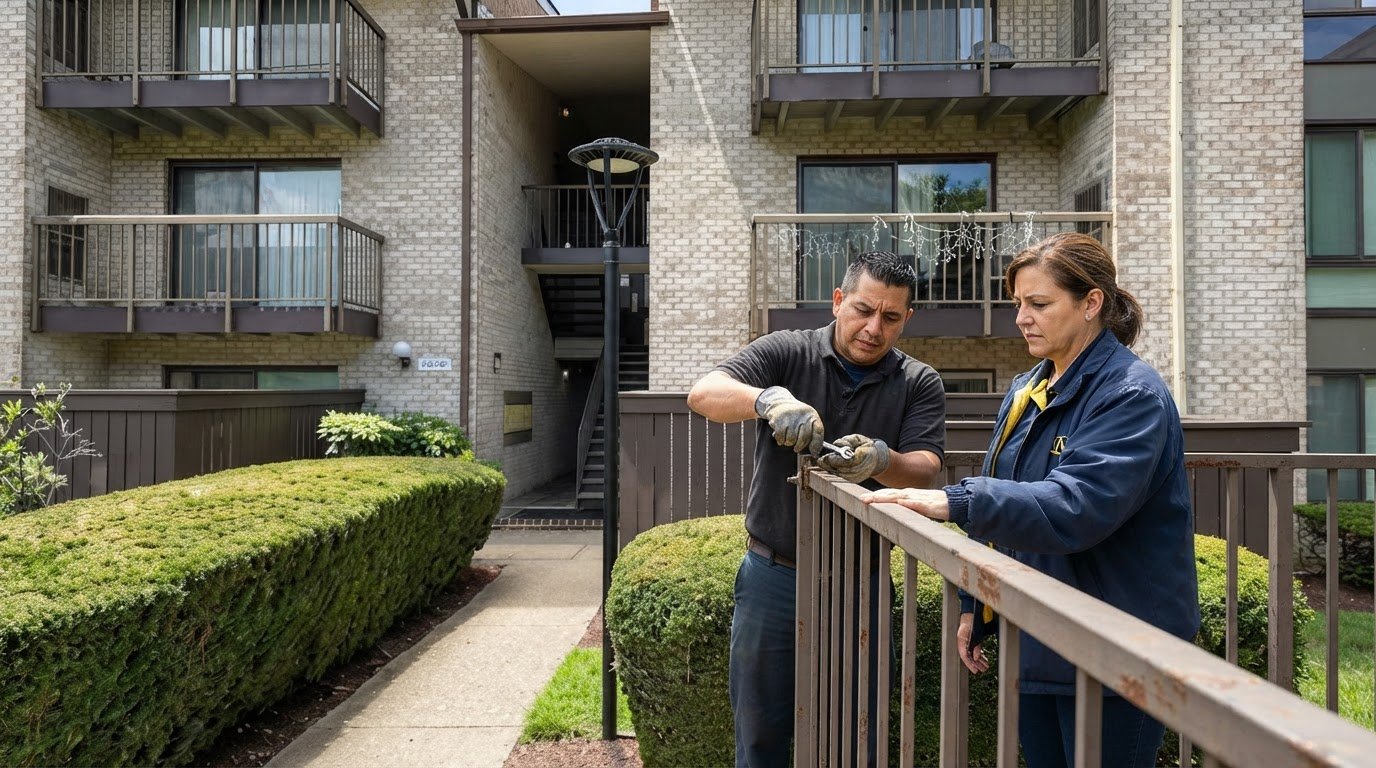
Regular property inspections can identify damage, check safety equipment, and flag repairs early. A practical inspection record notes the area reviewed, its condition, the required follow-up, and whether the work is complete. For example, documenting a damaged stair rail and its repair creates a clearer record than relying on memory. These steps can help reduce the risk of unresolved maintenance concerns, code issues, and tenant disputes.
What are average rents, vacancy rates, and operating costs for multifamily properties in Prince George’s County? Rental income and occupancy depend on factors such as unit size, condition, location, and tenant demand. Operating costs reflect expenses such as maintenance, utilities, and insurance. Track income and expenses by unit to see how vacancies or repairs affect rental revenue.
What are the risks of managing multifamily properties in Prince George’s County, including code violations and tenant disputes? Missed repairs, incomplete records, and unclear communication can make problems harder to resolve. Regular inspections and documented follow-up help owners spot issues and respond proactively.
Consistent property inspection coordination can help keep maintenance observations and follow-up organized across a rental property.
Maintenance response and contractor networks
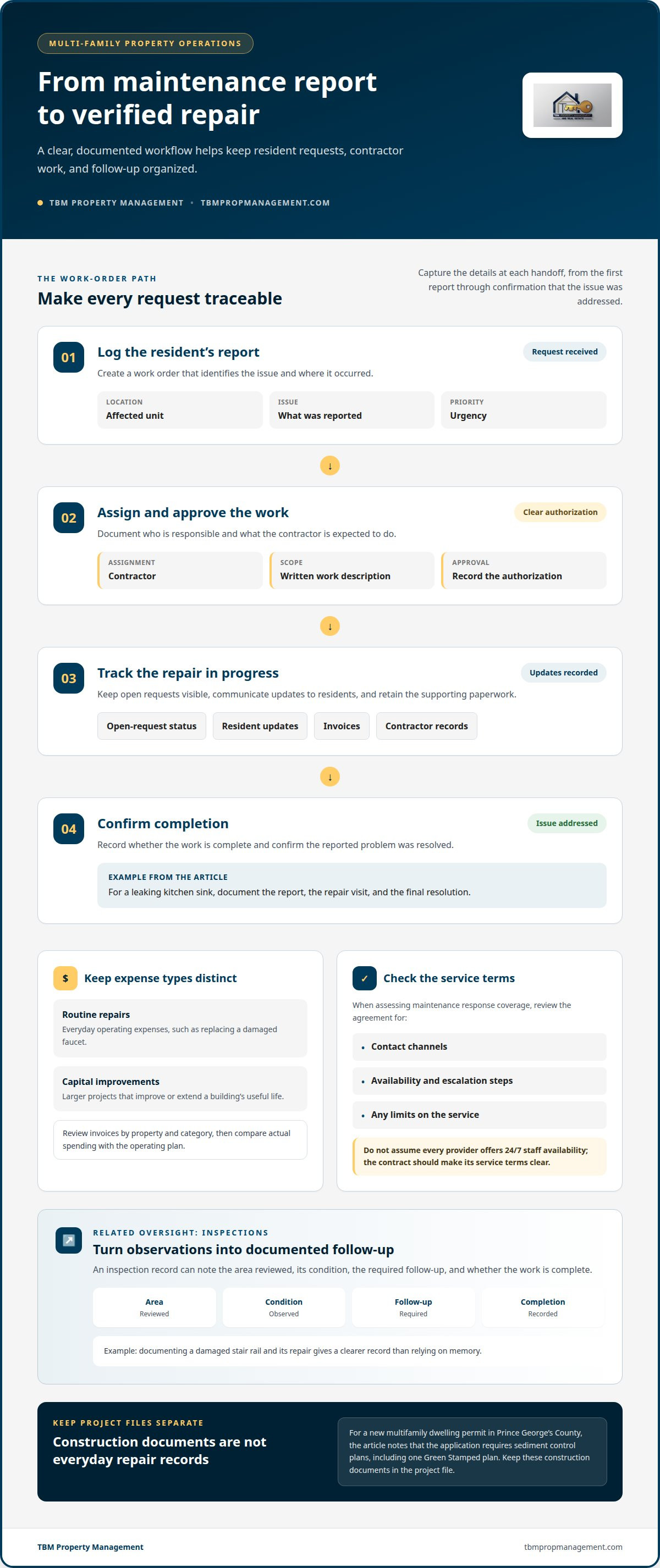
A reliable maintenance process turns each resident report into a documented work order. Record the affected unit, reported issue, urgency, assigned contractor, approval, and completion status. For example, a leaking kitchen sink needs a clear record of the report, repair visit, and final resolution. This history supports budgeting and helps prevent recurring problems from getting lost among leasing tasks.
Separate operating expenses from capital improvements in property records. Routine repairs, such as replacing a damaged faucet, differ from larger projects that improve or extend a building’s useful life. Review invoices by property and category, then compare actual spending with the operating plan. This gives landlords a clearer picture of how maintenance affects rental income and cash flow, without mixing everyday costs with capital work.
Contractor oversight should include written work descriptions, approval records, invoices, and confirmation that the reported issue was addressed. A maintenance coordinator can track open requests and communicate updates to residents. When assessing response coverage, read the agreement for stated contact channels, availability, escalation steps, and any limits. Avoid assuming every provider offers 24/7 staff availability; the contract should make its service terms clear.
Construction also involves distinct planning requirements. An application for a new multifamily dwelling permit in Prince George’s County requires sediment control plans, including one Green Stamped plan. Keep these construction documents in the project file, separate from everyday repair records. Clear documentation helps owners distinguish an active development project from routine maintenance at an occupied rental property.
If the management relationship ends, follow the contract’s termination and notice provisions. Note the required notice method and period, effective date, and transfer process for open work orders, contractor invoices, tenant records, and property access. Confirm who will handle outstanding repairs during the transition. An orderly handoff supports continuity for residents and gives the landlord a clearer view of remaining costs, leasing activity, and income records.
Multi-family property management fees
A management fee is useful only when it corresponds to clearly defined work. Read the agreement for included tasks, billing basis, payment timing, and separately charged services. One property management company may include rent administration and tenant communication, while another may charge separately for leasing or maintenance coordination. Compare scope before pricing so you know what each fee covers.
For a multi-unit portfolio, clarify how the fee applies to each property and its occupancy. Ask whether the agreement’s calculation changes when a unit is vacant, a new tenant is placed, or a lease is renewed. For a building with several occupied units and one turnover, the agreement should explain which tasks remain part of ongoing management and which involve a separate charge.
Also distinguish the management fee from property expenses. Contractor invoices, replacement materials, insurance, and capital improvements affect cash flow but are not automatically included in management pricing. Review how repairs are approved, how invoices are recorded, and whether the owner receives itemized financial reports. These details help connect property operations with local rental conditions and the owner’s investment goals.
The price depends on the property, unit count, occupancy, and service scope, and is provided after a quote request. For a useful comparison, match each proposed fee to a responsibility: tenant communication, rent administration, leasing, inspections, or maintenance coordination. Then identify exclusions, additional charges, and contract terms that affect billing during a vacancy or transition.
Owners should assess value by considering time, oversight, and consistency, not by fee alone. A clearly written agreement makes responsibilities easier to track across a portfolio and helps prevent overlooked work. For managing multi-family properties in Prince George’s County, request a property management quote to discuss the scope that fits your property.
TBM Property Management
TBM Property Management can help owners bring tenant coordination and day-to-day oversight under one management approach. Its Full-Service Property Management connects leasing, rent collection, and ongoing property needs, giving owners a consistent point of coordination. If you’re preparing a multifamily property for new residents, Tenant Placement and Leasing Services can support the process. If rent tracking and follow-through are taking too much of your time, Rent Collection can help keep that responsibility organized.
Consider professional management when multiple units compete with other responsibilities or tenant transitions and rental administration need more consistent attention. The right arrangement should fit the property and clearly define responsibilities. Contact TBM Property Management to discuss support for your Prince George’s County property.
Set a Clear Plan for Your Property
Your next step is to build a management plan around your property and goals. Decide what you want to oversee directly, where you need support, and how you want updates and decisions handled. A clear conversation about those expectations can make managing multi-family properties in Prince George’s County more deliberate and manageable.
TBM Property Management offers Full Service, Full Management, and Tenant Placement & Leasing Only. These options support owners who want help coordinating ongoing property needs or preparing for a tenant transition. Choose the level of involvement that suits your circumstances, then discuss how responsibilities would be structured.
Contact TBM Property Management today to discuss your property and the support you’re looking for. A well-defined next step can help you move forward with greater clarity.
Frequently Asked Questions
Can I terminate my contract if I’m not happy with the service?
Yes, if your agreement allows termination and you follow its notice requirements. Read the cancellation clause for the notice period, delivery method, any termination charges, and effective date. For example, send notice using the method stated in the contract and keep a copy. Before the handoff, clarify responsibility for open repairs, tenant communications, records, and funds.
What are the advantages of using a property management firm instead of managing the property myself?
A property management firm can take on recurring operational tasks, leaving you more time for ownership decisions instead of daily administration. Coordinating leasing, tenant placement, rent collection, and maintenance follow-up can create a more consistent process across several units. The benefit depends on the agreement and how well its services match the time and oversight you want to retain.
What rental licenses and inspections are required for multifamily properties in Prince George’s County?
Requirements depend on the property and its rental use, so distinguish rental licensing from inspections and construction permits. Review applicable state, county, and federal requirements, then organize license documents, inspection records, and repair follow-up by property. Regular inspections can identify damage, check safety equipment, and flag repairs early. Keep dated records of what was observed and how it was addressed.
What zoning, building, fire, and occupancy rules apply to multifamily rentals in Prince George’s County?
Applicable rules depend on the property’s location, approved use, building condition, and occupancy arrangement. For a practical review, organize zoning and permit records alongside inspection findings, safety-related maintenance records, and unit information. An application for a new multifamily dwelling permit uses the County’s Momentum portal and Permitting System. That construction process is distinct from the requirements for operating an existing rental.
What are typical multifamily property management fees in Prince George’s County and the DC suburbs?
There isn’t one fee that applies to every multifamily property. The agreement’s scope and billing method determine the cost. Compare what each proposal covers, such as rent administration, leasing, tenant communication, and maintenance coordination, then note excluded tasks and separate charges. Unit count, occupancy, turnover needs, and owner involvement can affect the arrangement. Evaluate the responsibilities covered, not just the headline fee.
How do landlords register rental properties and apply for rental licenses in Prince George’s County?
Start by identifying the property’s location and rental use, then gather relevant ownership, unit, and inspection information. Follow the County’s rental registration and licensing process for that property type, and retain application records and correspondence. Don’t confuse rental licensing with a building permit: applications for new multifamily dwelling permits are submitted through Momentum and the County’s Permitting System.